Prologue: This is a scaffold that I have been developing over time, adapted from an assignment that one of my Teacher Ed professors assigned us to do when completing his readings every week.
During my undergrad in one of my Teacher Ed classes, one of our weekly assignments for the class readings was to use a table to organize our annotations. We were tasked to find parts of the essays/readings that seemed important to us to share in discussion by organizing it into three columns: quotes from the text, our thoughts of what it means, and questions we have.
It was honestly a mundane task and it didn’t really give me a sense of purpose for completing the assignment other than homework points or not feeling behind my colleagues. I don’t really remember when I started using this tool for my own organization and sanity. I vaguely remember during the course my professor said the table/chart would be a good quote bank in the future, but never really gave any other purpose for it except for preparing us for discussion by having evidence ready for our class.
I figured it would be a good annotating tool for my students because I saw it as a way to streamline the essay writing process and maximize the drafting time to focus on refining the essay rather than trying to figure out the direction of the essay after only when the essay is assigned.
This took the last two semesters [about 4-5 units] to refine. Similarly to my professor, I simply just assigned the “Metacognitive Annotation Organizer” [what the handout was originally called] to my students as they read a series of short stories. At the time I added reading comprehension questions as well, but there wasn’t a clear connection between the annotations and the reading questions. Although students produced great work, it almost became too much for one homework assignment every time I assigned a short story.
During my first year, I wasn’t sure whether students should use sticky notes to annotate or not. I was so conditioned by my own high school experience and student teaching that I thought it was the only way. But I would also often assign the “Metacognitive Annotation Organizer” as a separate homework assignment and advise students that the places in the text they sticky-noted would be good for the Organizer.
I came to the conclusion that sticky note annotations were too cluttered and more often didn’t show me student’s thinking. Because I kept assigning a quota of sticky notes per chapter, students were just stuffing them in wherever. And I would lose class time flipping through every book just to check student’s annotations. I needed a more efficient system.
As my coach helped me streamline the grading process, he suggested that I have students self-assess their sticky notes with a rubric. I later ended up incorporating an example into the “Literary Analysis Annotation Organizer” along with essay prompts to give students a sense of direction as they annotate.
——————
I created the “Literary Analysis Annotation Organizer” because I found sticky notes to be ineffective. From my own high school experience, I didn’t see the purpose of wasting sticky notes just to show my thinking. I also found it ineffective for writing essays, which was the ultimate goal of reading a text in English, because I wouldn’t always remember what I was thinking at the time I wrote that sticky note with a symbol to remind of character growth.
I used to call this the “Metacognitive Annotation Organizer” because it does require a student to be aware of one’s own understanding of their thought process, but I felt like that term confused students. Literary analysis is still daunting, but it is the skill that I want them to walk away with.
Literary Analysis Annotation Organizer Overview
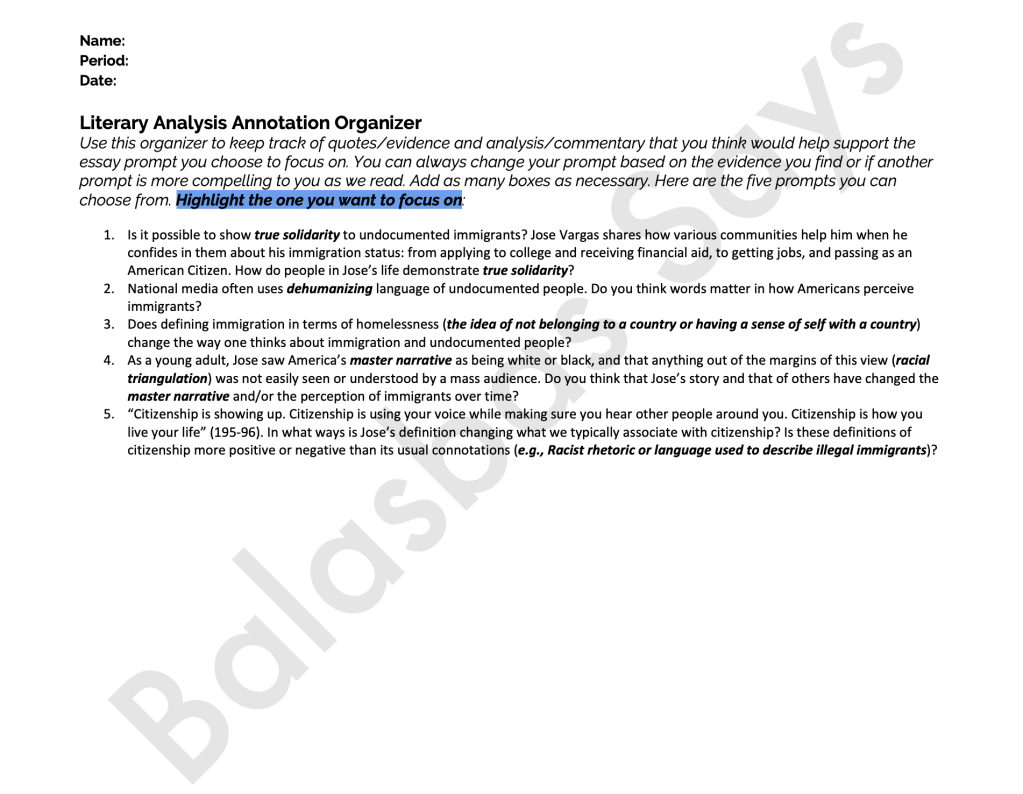
This 1st page where I have essay prompts is for students to select from for their essay after finish a text. The purpose of having these is for students is to have a guide when annotating, but also helping them track evidence for the prompt of their choosing instead of using essay writing/drafting time doing so. Essay Prompts Examples for teaching – Dear America: Notes of an Undocumented Citizen by Jose Antonio Vargas, 11th Grade American Literature
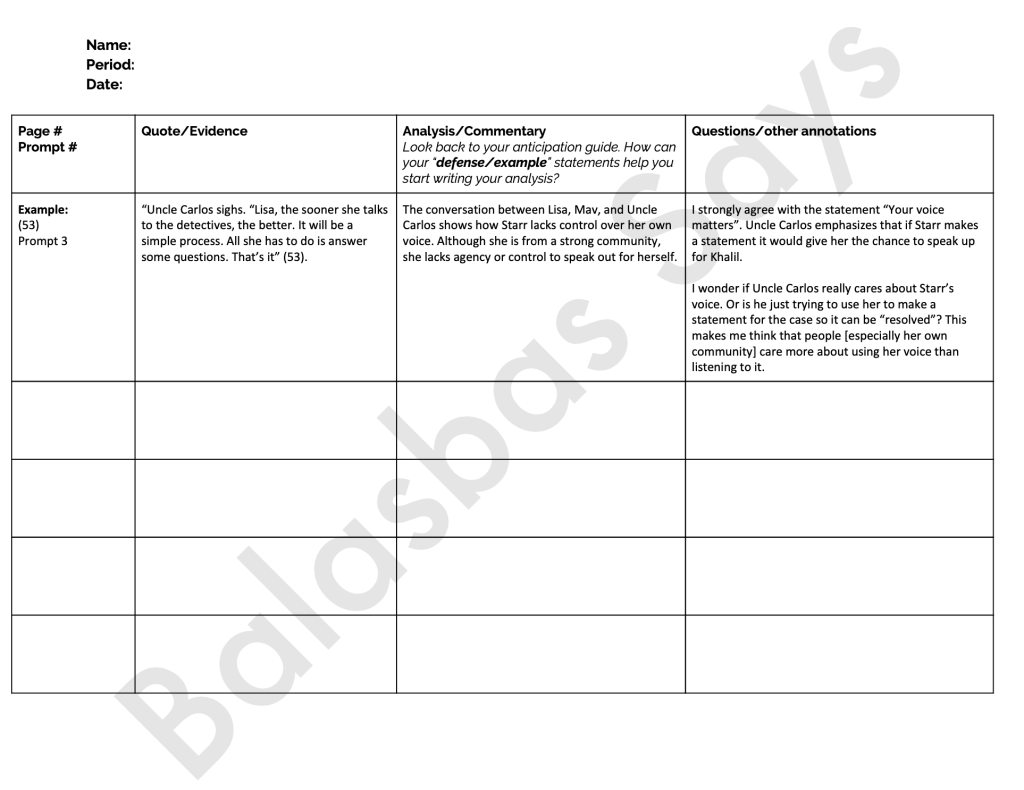
This scaffold can be used electronically or printed for students who prefer to write. If your site has access to computers or as an educator you are trying to promote technological literacy:
- This is a great way for students to organize their evidence for the essay instead of trying to sift through sticky notes at the last minute.
- It’s a task that asks students to demonstrate their thinking in a low-stakes way, I personally don’t expect students to be grammatically correct or formal, but at the least code-switch.
- I have found that this gives students [and from my own experience using this] a sense of purpose when reading. Not simply to fill out the table for the grade, but having a space to express my ideas on the evidence before a formative assessment/high stakes assignment like an essay.
- Since this document is electronic, students can copy and paste their evidence & analysis into their essays. I have found that this tool allows students to practice essay writing before the actual essay. Building the meat of their body paragraphs before the first draft and workshopping process.
Epilogue: This task has been more effective in students showing their thinking, my students ask great discussion questions or are better able to express their thinking. I can see where students are struggling, grappling, and comprehending the text.
But there’s a lot that could be improved when teaching this tool. I have never really modeled in-class how to use the table. I have just assigned it to students and have been collecting student answers as the exemplar grade. Students figure it out over time, but I definitely think it would be useful to read with students first, show them what I would annotate.
Only recently have I showed varying student examples of what I would grade as emerging, meeting the standard, and moving towards mastery.
I also need to find ways to use this tool outside of essay writing. Students ask great questions and more often than not they’re trapped on this document for only my eyes to see. Maybe a socratic seminar or discussion that requires students to use their annotations would give another purpose for students doing this assignment.
Here’s a link to a copy of the resource and California Common Core State Standards that align with the scaffold. Feel free to share or use it in your own classroom!
 Balasbas Says